
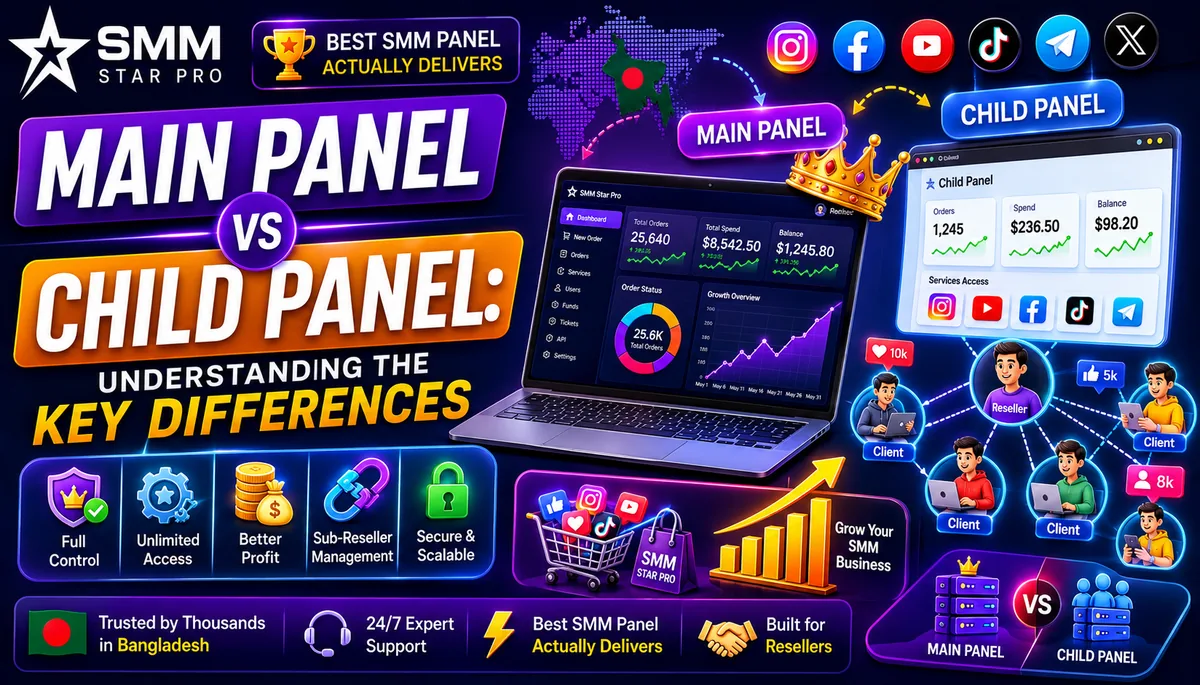
A main panel buys services straight from the suppliers. A child panel is a rebranded reseller shop that pulls those same services through an API and adds its own markup.
Here is the short version. A main panel is a large provider wired directly into wholesale suppliers. It holds the inventory, sets the base prices, and sells to both regular buyers and resellers. A child panel is the smaller storefront sitting on top of it, pulling the exact same services over an API and selling them at a higher retail price under its own brand. Think of the main panel as the wholesaler and the child panel as the shop on the corner that stocks its shelves from that wholesaler.
If the whole category still feels fuzzy, it helps to first read up on what these panels actually are before you pick a side. This guide compares the two so you can match the right one to your goal, whether that is buying cheaply for yourself or building something you can sell.
What is a main panel?
A main panel, sometimes called a provider or master panel, is the upstream source. A few traits set it apart. It connects straight to the original account networks and their APIs, so it is not buying from some other panel up the chain. It carries real inventory and sets the wholesale rate that everyone downstream prices against. It runs at a bigger scale too, which means balance systems, payment processing, fraud handling, and actual relationships with the suppliers behind the engagement.
And it serves resellers. A main panel exposes an API so child panels can pull its service list and pass orders straight back without anyone touching them manually.
Because it sits closest to the source, a main panel usually has the lowest prices and the steadiest fulfillment. The catch is that it takes more money and more operational know-how to run one.
What is a child panel?
A child panel, also called a reseller panel or white-label panel, is a ready-made storefront that hooks into a main panel over an API. It needs no supplier relationships of its own, since it inherits the main panel’s full catalog automatically. The reseller gets their own domain, logo, and pricing, so to customers it looks like a standalone business. Profit comes from markup: you buy at the main panel’s wholesale rate and sell at retail, keeping the gap. Startup cost is low, and plenty of providers hand you a child panel for a small one-time or monthly fee.
If your aim is to start selling without building infrastructure from scratch, a child panel is the quickest route in. You can spin one up through our white-label reseller setup.
How do they compare side by side?
Lined up against each other, the differences come down to a handful of things. The main panel connects directly to suppliers; the child panel connects to the main panel. The main panel sets wholesale prices; the child panel adds a markup on top. The main panel demands real capital and operational effort; the child panel runs on a small fee and comes pre-built. One gives you the lowest cost and the most control. The other gives you speed and almost no setup. If you want the mechanics of how an order travels through that chain, the breakdown of the way a panel processes and delivers orders fills in the technical side. For a buying decision framed around your goal rather than the wiring, our look at choosing between a main panel and a reseller panel walks through which to pick.
When should you use a main panel?
A main panel makes sense when you buy in high volume and want the cheapest possible cost per order. It also fits agencies juggling many clients who need direct, dependable fulfillment rather than a layer of middlemen. And it is the natural choice if you plan to become a provider yourself and resell to child panels further down the chain.
The price you pay is cost and complexity. Operating at the main-panel level means you are the one managing suppliers, payments, and support directly.
When should you use a child panel?
A child panel fits when you want to start a reselling business without much money up front. It works if you would rather have a storefront handed to you than build one. And it is a sensible way to test the market before you commit to anything bigger.
The trade here is margin. You pay a little more per order than a main-panel buyer would, because your prices already include the main panel’s cut. What you get back is a business that runs out of the box. This is the same call every creator faces when choosing a provider in the first place, which is really a question of how much you want to manage versus how fast you want to launch.
How does the money flow work?
The economics are just markup stacked on markup. Say a supplier sets a base cost of $0.50 per 1,000 followers. The main panel adds its margin and lists it at $0.80. The child panel reseller adds their own markup and sells it at $1.50. The end customer pays that $1.50, and the reseller pockets roughly $0.70 in profit per 1,000.
Since the API handles fulfillment on its own, the reseller’s real work is marketing, pricing, and support, not delivery. That low overhead is the whole reason child panels work as a business model, and it is why a closer look at how much a child panel can actually earn is worth your time before you launch.
Can a child panel become a main panel?
It can, and many do. Plenty of providers start out as resellers on a child panel, build a customer base, and then move up to direct supplier relationships, which effectively turns them into a main panel. The usual path runs from child panel, to high-volume reseller with better wholesale rates, to direct API integration with the original suppliers. If that is where you are headed, the smart move is to start small as a reseller and grow into it rather than trying to skip the early steps, which is exactly the path our guide on starting an SMM reseller business lays out. A flexible social media growth service gives you room to make that jump when the numbers justify it.
Frequently asked questions
What is the difference between a main panel and a child panel?
A main panel connects directly to engagement suppliers and sets wholesale prices. A child panel is a rebranded reseller storefront that pulls those services through an API and resells them at a markup.
Is a child panel the same as a reseller panel?
Yes. “Child panel,” “reseller panel,” and “white-label panel” all describe the same thing: a storefront that resells a main panel’s services under its own brand.
Which is cheaper, a main panel or a child panel?
A main panel is cheaper per order because it buys closest to the source. A child panel adds the reseller’s markup on top.
Do I need technical skills to run a child panel?
No. Child panels arrive pre-built with API integration, payment processing, and the parent’s full catalog. Your job is branding, pricing, and customer support.
Can I make money with a child panel?
Yes. You earn from the gap between the main panel’s wholesale price and your retail price, and the overhead stays low because fulfillment is automated.
Thinking about reselling? Launch your own branded storefront, set your own prices, and start earning from markup without much money up front.