
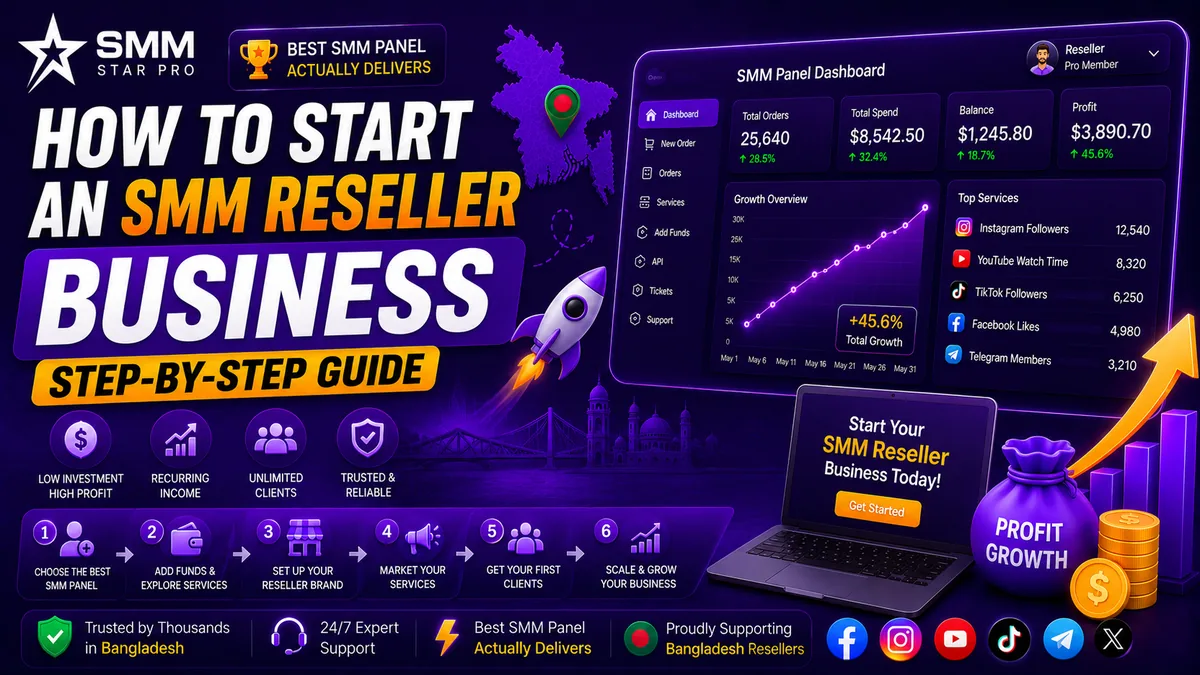
How to start an SMM reseller business: choosing a panel, setting markup pricing, launching a child panel, and taking payments. A practical, profit-focused walkthrough.
Starting an SMM reseller business means you buy social media services such as followers, likes, and views wholesale from a main provider, mark them up, and resell them through your own child panel or website. The cost to get going is small, often under $50, and you keep the gap between the wholesale rate and your retail price on every order that comes in.
A reseller sits between a wholesale provider and the people actually buying. You do not deliver the engagement. The provider’s supply network handles that part. What you do is find reliable services at a good price, put your brand on them, price them so they make money, and take care of payments and customer questions. Fulfillment runs through an API, so the model scales without you touching individual orders one by one.
What is an SMM reseller business?
An SMM reseller business resells social media marketing services that come from a wholesale provider. The provider runs a “main panel” with direct supplier connections and low base prices. You run a “child panel,” which is a branded reseller storefront wired into that main panel, and you set your own retail prices. So when a customer orders 1,000 Instagram followers on your panel, your panel quietly places the same order on the main panel at the wholesale rate, and you keep what is left over.
The supply chain is short: a supplier feeds the main panel, the main panel feeds your child panel, and your child panel serves the customer. You never deal with bots, servers, or delivery yourself. That relationship between a parent panel and the storefront sitting on top of it is the same idea I break down when comparing the two panel types side by side, and it is the reason this business is friendly to beginners.
How much money do you need to start?
You can open an SMM reseller business for $10 to $50. The spending falls into three buckets:
- Panel or script. A hosted child panel from a provider is usually free or under $10 a month. A self-hosted script like PerfectPanel or SMMPanelScript runs $20 to $100 one time, plus hosting.
- Starting balance. Put $10 to $30 with your main provider to fund your first customer orders.
- Domain and branding. Budget $10 to $15 a year for a domain if you want your own URL.
The low cost is the whole point. You are not buying stock that sits on a shelf. You fund an order only after a customer has already paid you, so your working capital keeps recycling itself. Plenty of resellers pour their first week of profit back in and never add another dollar of their own. If you want to see how the revenue actually adds up over time, I went through the math in a separate piece on the kind of income a child panel can realistically bring in.
Step-by-step: how to start an SMM reseller business
- Choose a reliable main panel (your supplier)
This is the decision that matters most. Your reputation lives and dies on the provider’s delivery speed, refill quality, and uptime. A few things to weigh:
- Service catalog. Does it cover the platforms your buyers care about, like Instagram, TikTok, YouTube, and Facebook?
- Refill and refund policy. Drops happen. You need automatic refills so you are not eating the loss.
- API availability. This is required for automated fulfillment, so do not skip it.
- Pricing. Low base prices leave you room to mark up.
- Payment options. Make sure you can actually top up your balance without a hassle.
SMM Star Pro works as both a main source and a reseller source, so you can look at the wholesale rates and the supported service list directly on the reseller panel page before you commit to anything.
- Decide between a child panel and a main panel
A child panel is the quickest way in. The provider hands you a ready-made, branded reseller storefront connected to their supply, free or for a small fee. A main panel, meaning your own independent panel with direct supplier API keys, gives you more control and fatter margins, but it asks for technical setup, several supplier accounts, and more capital. If you are unsure which fits you, the side-by-side look at a main panel versus a child panel spells out the trade-offs. Most people start with a child panel and move up later once they know the business is working for them.
- Set up your panel and connect the API
Order your child panel from the provider, point your domain at it, then add your logo and brand colors. If you are running your own script instead, you connect to the provider through their API by pasting in the API URL and key, then importing the services. I wrote out the full process for wiring a panel to a provider’s API if you want every step. Once it is connected, any order placed on your panel forwards to the provider on its own.
- Price your services for profit
Import the provider’s services at wholesale cost, then put a markup on top. Common markups run anywhere from 20% to several hundred percent depending on the service and your market. Cheap, high-volume services like Instagram likes carry thin margins but turn over fast. Premium services such as high-retention YouTube views or country-targeted followers can handle a heavier markup. Use a percentage markup rather than a flat one so your prices adjust by themselves when the provider changes its rates. The markup math, the psychology behind round and odd prices, and how to build tiered packages all get their own treatment in my guide to pricing SMM services without leaving money on the table.
- Add payment methods
Connect the gateways your customers will actually reach for. The usual options:
- Cards and global. Stripe, PayPal (keep in mind PayPal sometimes restricts SMM-related accounts), Perfect Money, Coinbase Commerce, and USDT or other crypto.
- Regional. Local mobile wallets and bank transfers for whatever country you are targeting. If Bangladesh is that market, our guide on starting an SMM business in Bangladesh covers bKash and Nagad collection in detail.
Crypto and regional wallets are popular here because card processors can get twitchy about this category. Offer at least two methods so you are not losing buyers at checkout over a payment option they do not have.
- Launch, market, and support
Announce your panel where your buyers already hang out: Telegram groups, Instagram growth communities, freelance marketplaces, and reseller forums. Your real edge is service. Fast replies, honest delivery times, and refills when orders drop. A reseller who answers tickets in minutes keeps the customers that a cheaper but silent competitor ends up losing.
How does an SMM reseller make a profit?
Profit comes from the spread between the wholesale and retail price, multiplied by how many orders you process. Here is a quick example.
A panel handling 200 orders a day at an average of $1 profit each clears roughly $6,000 a month before marketing costs. Each order is small on its own, but volume and automation stack up. Since fulfillment is automatic, your hours go into marketing and support rather than delivery.
Is reselling SMM services legal?
Reselling SMM services is legal in most places. You are reselling a marketing service, which is not unlawful on its own. The grey area is at the platform level. Buying engagement can break the terms of service on Instagram, TikTok, or YouTube, but that is a contractual matter between the end user and the platform, not a criminal one. As a reseller you should:
- Use a provider with high-quality, drop-resistant services so you are protecting your customers’ accounts.
- Be honest about what each service actually delivers.
- Register your business and handle taxes under your local law once revenue starts to grow.
Treat it the way you would any e-commerce business. It is legitimate, so just run it cleanly.
Common mistakes new resellers make
- Picking the cheapest provider without checking anything. Rock-bottom prices often come with fast drops and no refills, and that wrecks your reputation.
- Pricing too low. Racing to the bottom kills your margin and tells buyers your service is cheap for a reason. Compete on reliability and support instead.
- No refill policy. When followers drop and you cannot refill, you end up paying refunds and losing customers.
- Only one payment method. Every gateway you leave out is a slice of buyers who simply cannot pay you.
- Treating support as an afterthought. In this niche, how fast you respond is basically the product.
Frequently Asked Questions
How much can I earn as an SMM reseller?
Earnings scale with order volume and markup. Small panels make a few hundred dollars a month. Established panels with steady traffic pull in four to five figures. The numbers depend heavily on your traffic and the niche you serve.
Do I need technical skills to start?
No. A hosted child panel needs no coding at all. You brand it and set prices through a dashboard. For self-hosted panels the API integration is mostly copy and paste, which I cover step by step in the integration guide linked earlier.
Child panel or main panel for a beginner?
Start with a child panel for the speed and the near-zero setup, then graduate to a main panel once you have steady volume and want higher margins.
How do I get my first customers?
Promote in Telegram and Instagram growth communities, freelance marketplaces, and reseller forums. Lead with reliability and fast support rather than the lowest price. If you ever want a hand thinking through your setup, you can always reach out to the support team.
How fast are orders delivered?
Delivery is automatic and depends on the provider’s supply. Reliable main panels start most orders within minutes, which is exactly why your choice of provider protects your delivery reputation.
Want to source services at wholesale and resell them at your own price? Head over to the SMM growth platform and launch your child panel.