
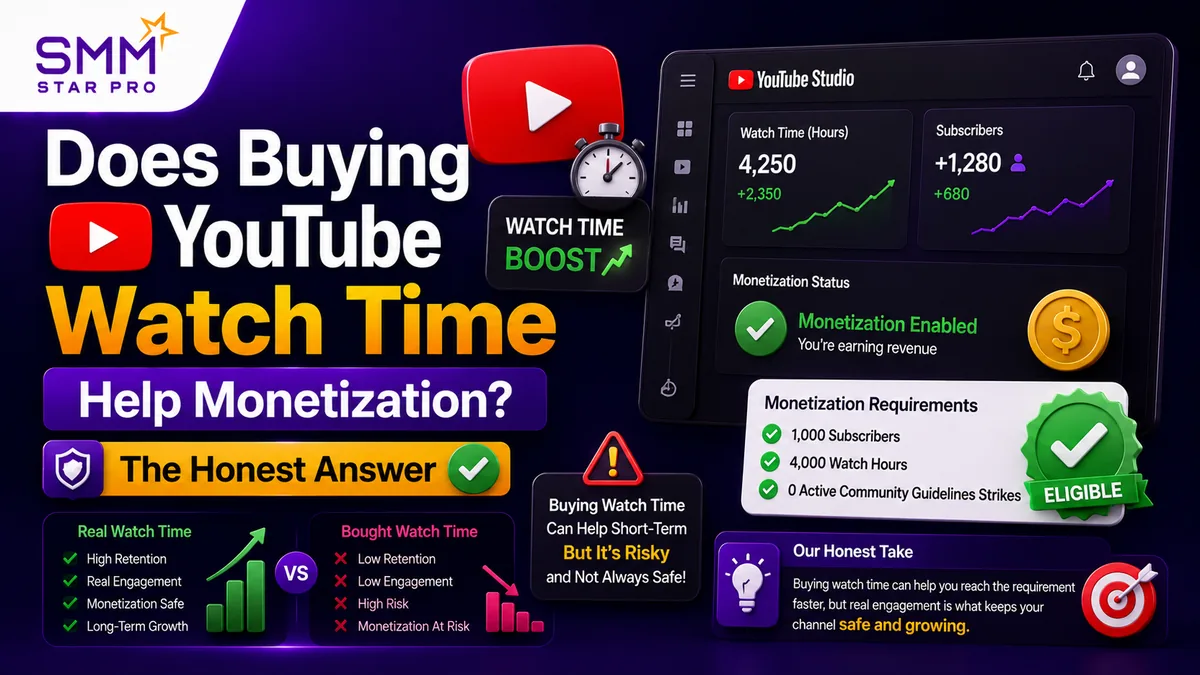
Does buying YouTube watch time help monetization? It can get you to the 4,000-hour line faster, but only quality, retained watch time actually counts. Here are the honest risks.
Buying YouTube watch time can move you toward the 4,000 public watch hours you need for monetization, but that only holds if the hours come from sessions that look real and hold viewers for a meaningful stretch. Low-quality watch time from bots gets discounted by YouTube, rarely survives review, and puts your whole application at risk. Quality and retention are what decide whether the hours count at all.
The YouTube Partner Program asks for 4,000 valid public watch hours (or 10 million Shorts views) plus 1,000 subscribers inside a 12-month window. Watch time is by far the hardest of those to earn on your own, which is exactly why people pay for it. So here is what genuinely helps and what just burns money.
What watch time does YouTube count for monetization?
YouTube counts valid public watch hours: the time people spend watching your public videos over the trailing 12 months. It leaves out private videos, unlisted videos in some cases, deleted videos, and any traffic the platform flags as invalid, such as bots, incentivized clicks, and artificial sessions.
That last exclusion is where all the risk lives. YouTube’s systems look at whether the watch time resembles real human viewing. They weigh session length, the shape of your retention curve, whether the viewer does anything while watching, and where the traffic came from. Bought hours that fail those checks get filtered out and never touch your 4,000. You can pay for a full 4,000 hours and watch the meter barely twitch if the quality is bad.
Can you actually buy watch time that counts?
Sometimes you can, and this is the part where being honest matters. There are really two tiers to think about.
- Bot watch time. These are automated sessions, usually with terrible retention, the kind of “view” that bails after four seconds. YouTube discounts most of it. It pumps up your raw numbers but almost never makes it through the monetization review, which combines algorithmic screening with a manual look.
- Real-looking, retained watch time. Sessions from accounts that read as real and watch a decent chunk of the video. This behaves more like organic viewing and has a better shot at counting.
Even the better tier is no guarantee. The monetization review is stricter than the everyday metrics you see on your dashboard. Watch time that fattens your analytics is not the same as watch time YouTube will validate for the Partner Program. So treat bought watch time as a way to build momentum, not a paid shortcut around the review.
Is buying watch time against YouTube’s rules?
YouTube’s terms forbid artificially inflating metrics, and the Partner Program review is built to catch it. Channels that hit the threshold mostly through obviously fake watch time can get rejected from monetization, and repeat offenders can see the channel itself actioned.
The stakes here run higher than something like buying Instagram engagement, because monetization is a deliberate checkpoint where someone is actively looking. If you want the wider policy context, our breakdown of how risky it is to pay for social proof goes into it, but the YouTube-specific lesson is simple: the closer your bought activity sits to genuine viewing behavior, the safer and the more useful it is.
What actually moves the needle on monetization?
The blunt version is that real watch time from real viewers is the only thing that reliably counts, and it comes from retention. A video people stay with to the end produces more valid watch hours per view and tells the algorithm the content is worth showing. YouTube then pushes it to more real viewers, and those hours start to compound on their own, which is the heart of growing a YouTube channel the sustainable way.
Bought watch time, at its best, primes that pump. It can hand a fresh upload some early session data that nudges YouTube into testing it with real audiences. But the hours that stick around still come from content people choose to watch. Most of the lift comes from the retention tactics that raise your watch time: a strong hook, tight pacing, smart playlists, and end screens that carry one view into a longer session and turn a single video into a binge.
When does buying watch time make sense?
Think of it as a momentum tool for a few specific situations.
- You are close to 4,000 hours and want to clear the line before your 12-month window ages older hours out.
- You have videos with strong retention that deserve more reach, and you want to feed YouTube early session data so it tests them wider.
- You are seeding a brand new upload and want to give it some initial traction.
It does not make sense if your retention is weak, your library is thin, or you are hoping bought hours alone will satisfy the review. In those cases you are paying for numbers that will never validate.
How to buy watch time more safely
If you decide to go ahead, a few things keep the risk down.
- Buy retained watch hours rather than raw views that last a few seconds. Ask the provider what the average view duration looks like.
- Pace the delivery across days or weeks. Thousands of hours landing overnight is about the loudest red flag you can send.
- Spread the hours across several videos instead of dumping them on one, so it mirrors how a channel actually grows.
- Stick with services that only need your username or URL, and never hand over login access to your channel.
- Keep publishing real content so genuine watch time backfills the bought hours before review.
Subscribers are the other half of the requirement, and the same quality rules carry over. Our walkthrough on growing your subscriber count covers how to clear the 1,000-subscriber mark without wrecking your channel’s credibility. Working with an established SMM service provider helps here too, since reputable providers tend to deliver the kind of activity that holds up under scrutiny.
Frequently asked questions
Does bought watch time count toward the 4,000-hour requirement? Only when YouTube validates it as real public watch time. Bot hours with poor retention get discounted often and may not count at all. Real-looking, retained sessions have a better shot, but nothing is guaranteed once the monetization review runs.
Can buying watch time get my channel rejected from monetization? Yes, if a big share of your hours looks artificial. The Partner Program review screens for inflated metrics, so quality and pacing matter far more than raw volume.
How much watch time can I safely buy? Keep the amounts modest, retained, and paced over days, and spread them across videos. The point is to supplement real growth near the threshold, not to manufacture the whole 4,000 hours.
Is buying views the same as buying watch time? No. Views can be very short, while watch time measures duration. For monetization, retained watch time is what counts. A thousand five-second views add almost nothing to your watch hours.
What helps monetization more than buying hours? High-retention content. Videos people finish generate more valid watch time per view and earn recommendations to real viewers, which is the only sustainable road to 4,000 hours.
Close to the threshold and want retained, paced hours from real-looking sessions? Take a look at our YouTube watch time packages.