
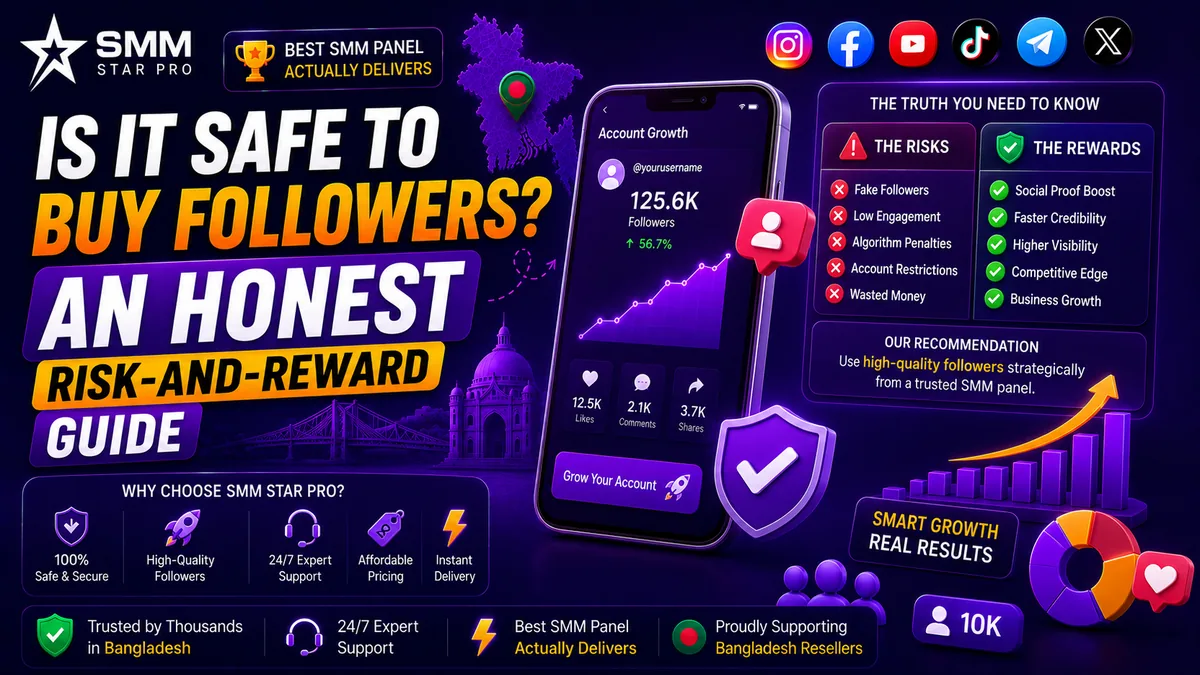
Is it safe to buy followers? Yes, if you use quality services and avoid bots. Learn the real risks, what platforms detect, and how to buy followers safely.
Buying followers is safe when you buy high-retention, real-looking accounts from a provider that knows what it is doing and you let the delivery arrive at a natural pace. It gets risky when you grab cheap bot accounts that platforms detect and sweep away, which is what causes those sudden follower drops and the quieter reach that follows. So the thing that decides the outcome is quality and method. The act of buying, on its own, is not the problem.
This is the honest version. Plenty of pages will tell you buying followers is either a magic shortcut or a one-way ticket to a ban. Both are wrong. Here is what actually happens, what each platform looks for, and how to do it without hurting the account you are trying to grow.
What does “buying followers” actually mean?
Buying followers means paying a service to add follower accounts to your profile. There are three broad tiers, and they are nowhere near equal:
- Bot followers. Empty accounts with no posts and no profile photo, churned out in bulk. Cheapest, lowest quality, and the first to get wiped in a platform sweep.
- High-quality, real-looking accounts. Aged profiles that have photos, posts, and a bit of activity. They stick around longer and they blend into your follower list instead of standing out.
- Real engaged followers. People reached through promotion, giveaways, or ad-style targeting who actually see your content. Most expensive, and the lowest drop rate of the three.
When someone asks whether buying followers is safe, they are usually picturing tier one while pricing tier three in their head. The safety question only makes sense once you pull those apart. If you want the difference spelled out, our look at whether purchased followers do anything for real engagement goes deeper on what each tier is actually buying you.
Is it against the platform’s rules to buy followers?
Buying followers sits in a gray area. Instagram, TikTok, YouTube, and Facebook all discourage “inauthentic engagement” somewhere in their terms. In practice, though, enforcement goes after the fake accounts themselves, not the profiles that received them. Platforms remove bot accounts in periodic purges, and the account that bought them just loses that part of its count.
Account bans purely for buying followers are rare, and when they happen they are usually tied to something else: spam, automation tools running on the login, mass-following bots operated from your account. The realistic worst case for most buyers is not a ban. It is wasted money on followers that evaporate inside two weeks. If you want a sense of who you are actually handing your username to, it helps to use an established social media marketing platform rather than whatever panel showed up first in a search.
What are the real risks of buying followers?
Be clear-eyed here. These risks are manageable, but they are real:
- Follower drop-off. Low-quality accounts get deleted by the platform. Buy 5,000 bots and you might be down to 1,500 a month later. Good providers cover this with a refill guarantee.
- Ratio damage. A profile with 50,000 followers and 12 likes a post screams manipulation to the algorithm and to anyone with eyes. The imbalance is the tell, not the follower number by itself.
- Reduced reach. Some algorithms care about engagement rate. Pile inactive followers onto a profile and that rate drops, which can quietly cut how often your real posts get shown.
- Reputation risk. Audits, brand partners, and sharp followers can spot a hollow audience. If you run a business account chasing sponsorships, this lands harder than it does on a hobby page.
- Payment and data risk. The genuine danger is a sketchy panel that asks for your password instead of just your public username. Never hand over your login.
Notice that “getting banned” is not sitting at the top of that list. The most common real-world cost is paying for followers that do not stick and do not engage.
What makes buying followers safe vs. risky?
A few variables move you from risky to safe, and pacing is the one people ignore most. Gradual delivery matters because a sudden spike is the single clearest manipulation signal a platform can read. A profile that gains 200 followers a day for two weeks looks like a profile having a good run. A profile that gains 20,000 in one afternoon looks like exactly what it is.
How do platforms detect fake followers?
Detection systems read signals, not intentions:
- Velocity. Unnatural spikes in follower count over short windows.
- Account quality of the new followers. No profile photo, no posts, default usernames, registration in bulk batches.
- Engagement mismatch. Followers who never like, comment, watch, or click.
- Geographic and behavioral clustering. Thousands of followers traced to one IP range or a single device farm.
This is why the type of account you buy decides the outcome. Bots fail every one of these checks. High-retention, real-looking followers paired with some genuine activity pass most of them. If you want an audience that can defend itself, what you are really paying for is the ability to survive these checks, and that is where the extra cost goes. It also helps to know how to tell real engagement from bot activity so you can judge a provider’s quality before you ever pay.
Does buying followers hurt your engagement rate?
It can, if you buy followers and nothing else. Engagement rate is interactions divided by followers, or by reach. Add 10,000 silent accounts and the denominator grows while the numerator sits still, so the rate falls. A falling rate can shrink your distribution on any platform that weights it.
The fix is to keep the ratio sane: pair follower growth with proportional likes, views, or comments so the profile still reads as active. The mechanics of why this works are laid out in our piece on how purchased followers affect your actual engagement numbers. The short version is that followers are a vanity layer and engagement is the layer the algorithm actually reads, so do not buy one without thinking about the other.
When does buying followers make sense?
It is a tactic, not a strategy. It works best as social proof, the threshold where a new visitor decides you are worth a follow because other people already do. Reasonable cases:
- New accounts crossing the “this looks established” line. The jump from 200 to 2,000 followers genuinely changes first impressions.
- Launches or campaigns where a credible follower count backs up a pitch.
- Platform milestones that unlock features, though when the milestone is a monetization threshold, real activity counts for far more, as we explain in our breakdown of whether buying YouTube watch time moves the monetization needle.
It does not replace content. Followers who do not care about your posts will not buy, share, or stick around. Buying followers buys you a first impression. Your content has to handle everything after that.
How to buy followers safely, a checklist
If you decide to do it, do it like this:
- Use username-only services. A legitimate provider never needs your password. Walk away from any that ask.
- Choose high-retention or real-looking tiers, not the cheapest bot package on the menu.
- Start small and drip it in. Order an amount that fits your current size and have it delivered gradually.
- Look for a refill or refund guarantee. This is your insurance against natural drop-off, and it is worth reading how a refill window is supposed to work before you buy so you know what you are actually covered for.
- Pair it with engagement. Add likes or views so the ratio stays believable.
- Keep posting real content. Bought followers are scaffolding. Your own output is the building.
If you want platform-specific steps, we have walkthroughs for growing a TikTok following the careful way and for adding YouTube subscribers without tripping the system. For likes on Instagram specifically, it is worth reading the things people wish they had checked before buying likes, and if you want one method that carries across every platform, see our guide to buying engagement without putting the account at risk.
Frequently asked questions
Can you get banned for buying followers? It is uncommon. Platforms strip out the fake accounts instead of banning whoever received them. Bans usually trace back to other violations, like running automation on your login, so it pays to follow the basics of keeping your social account safe. Sticking to a username-only service that never touches your credentials keeps the account itself out of the line of fire.
Will bought followers disappear? Low-quality bot followers often do, during platform purges. High-retention accounts last a lot longer, and a reputable provider will offer refills to replace any that drop inside the guarantee window.
Do bought followers see my posts? Bots do not engage at all. Higher-quality accounts may show up in reach metrics now and then but rarely interact in any real way. Treat bought followers as social proof, not as an audience that converts.
Is it better to buy followers or engagement? Engagement, meaning likes, views, and comments, is read more directly by the algorithm and keeps your ratios healthy. The strongest approach pairs a modest follower boost with proportional engagement rather than buying followers on their own.
How many followers is safe to buy at once? Buy an amount that matches your current size and have it delivered gradually. Doubling overnight from a small base is the clearest manipulation signal there is. Incremental, drip-fed growth is far safer.
Ready to grow with high-retention accounts and a refill guarantee? You can pick up Instagram followers here and start with a package sized to your account.