
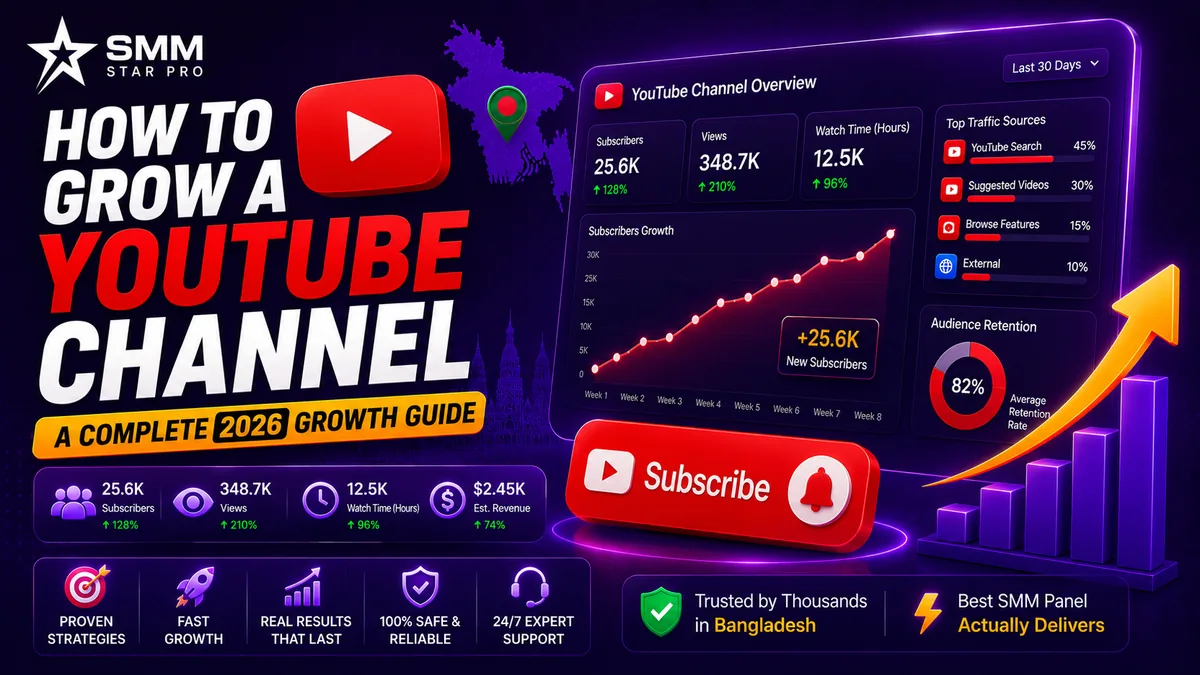
How to grow a YouTube channel in 2026: pick a niche, work with the algorithm, sharpen your titles and thumbnails, and turn views into subscribers.
If you want a channel that grows, the short version is this. Make videos that solve a real problem for one kind of viewer, package the title and thumbnail so people actually click, and keep them watching long enough that the algorithm decides you are worth recommending. Three things move the needle: how often people click, how long they stay, and how regularly you show up. Get those right and subscribers stack up on their own.
Most channels stall for two reasons. The creator makes videos about topics they personally enjoy instead of topics anyone is looking for, and the thumbnail gets thrown together five minutes before publishing. This guide covers the whole thing: finding a niche, packaging, the algorithm, retention, search, posting rhythm, and turning strangers into subscribers.
How does the YouTube algorithm decide who to show your video to?
The algorithm does not judge your video. It runs a test. The moment you publish, YouTube shows the video to a small group, usually your subscribers and people already browsing similar stuff. Then it watches two numbers more than anything else.
- Click-through rate, or CTR: the share of people who saw the thumbnail and clicked. For an established channel, anything between 4% and 10% is healthy.
- Average view duration, or retention: how much of the video people watched before they bailed.
Beat the average for your topic on both, and YouTube opens the gates. More impressions on the home feed, the suggested sidebar, search results. Fall short and distribution quietly stops. That is the whole reason a brilliant video with a flat thumbnail can sink, while an ordinary video with a thumbnail you cannot ignore and a strong first minute can run for months.
Two things follow from this. The thumbnail and title are not decoration you add at the end. They are the part that decides whether the video gets to compete at all. And the first 30 seconds set the shape of your retention curve, so put the good part up front and cut the throat-clearing intro.
How do you pick a niche that actually grows?
A niche worth building sits where three things meet: what you can keep making without burning out, what people actually want to watch or search for, and what someone (advertisers, an audience, a sponsor) will eventually pay for. Keep the lane narrow enough that a viewer can guess your next video before you make it.
Check demand before you marry the idea. Type your seed topics into YouTube search and read what autocomplete fills in. Those suggestions are real searches people are typing. Look for topics where individual videos pull far more views than the channel has subscribers. That gap tells you the algorithm is pushing the topic to people who do not follow the channel yet, and that is exactly the audience you need.
Two traps catch most beginners. One is going so broad (“lifestyle,” “gaming”) that no single video tells anyone what you do. The other is wading into a topic so dominated by huge channels that a newcomer never earns a single impression. You want a defined sub-topic with clear demand and competition you can realistically beat.
How do thumbnails and titles drive click-through rate?
The thumbnail does maybe 80% of the work of earning a click. The title closes the deal. They should team up rather than say the same thing twice. If the thumbnail already shows the result, let the title carry the stakes or the question.
What reliably lifts CTR:
- One clear focal point. A single face, a single object, one bold contrast. Clutter just reads as noise at phone size.
- Legible when it is tiny. Shrink it down to fingernail size. If you cannot tell what it is, neither can someone thumbing past it.
- An emotional or curiosity hook. A shocked face, a before and after, a number, an open loop like “I tried X for 30 days.”
- Titles around 60 characters or shorter so they do not get cut off on mobile, leading with the benefit or the keyword.
Treat packaging as something you keep tweaking. YouTube Studio lets you A/B test up to three thumbnails on the same video and it keeps the winner for you, so use that on every upload. If you want the deeper version of all this, our guide to thumbnails and on-page search walks through contrast, text hierarchy, and metadata as one connected system.
How important is watch time, and how do you increase it?
Watch time is the total minutes people spend on your videos, and it is the number YouTube optimizes the entire platform for, because more watch time means more ads it can sell. It is also your ticket into the YouTube Partner Program, which wants 4,000 valid public watch hours (or 10 million Shorts views) in the last 12 months, plus 1,000 subscribers.
You grow watch time in two directions. Keep each viewer watching longer, which is retention, and get each viewer to watch more of your videos in a row, which is sessions. For retention: hook them in the first 15 seconds, cut every dead second in the edit, throw in a pattern interrupt every 20 to 40 seconds (a camera change, some b-roll, text on screen), and actually deliver what the thumbnail promised. For sessions: end a video by pointing to a related one, and build playlists that auto-queue the next thing.
The full retention playbook, including hooks, pacing, end screens, playlists, and the watch-hours math behind monetization, lives in our breakdown of keeping viewers watching longer.
How do you get your first 1,000 subscribers?
The first 1,000 is the hardest because you have no audience to feed the algorithm with. The way through is to stop chasing raw views and start engineering the moment someone decides to subscribe. Give more than they expected, then ask for it outright.
What works early on:
- Make 5 to 10 videos answering specific, high-intent questions in your niche, so search becomes your first traffic source. Search does not need you to already have an audience.
- Ask for the subscribe at a high-value point in the video, not at the very start. Ask right after you have actually given them something useful.
- Pin a comment, turn on end screens, add a channel watermark. Keep the subscribe button one tap away at all times.
- Reply to every comment for the first few months. The people who bother to comment tend to convert and come back.
The complete milestone plan, with content cadence, the partner-program path, and what to do when you get stuck at a few hundred, is in our walkthrough on reaching that first thousand. Some creators trying to clear the partner-program bar a little faster also supplement organic growth with a small boost to social proof before they scale up the content side.
How does YouTube SEO get your videos found?
YouTube is the second-biggest search engine on the planet, and search traffic compounds for years because it does not decay the way feed traffic does. SEO is how you claim it.
Optimize each video for the exact query it is going after:
- Keyword in the title, written naturally. Match the phrase people genuinely type.
- Description: lead with your most important sentence and the keyword in the first two lines, since that is what shows above the fold. Then write 150 to 300 words that honestly describe the video. Add timestamps. Chapters help both the viewer and your ranking.
- Tags and hashtags play a small role now, but they still help clarify what the video is about.
- Filename and your spoken words count too. YouTube transcribes your audio, so say your target keyword out loud, early.
Pair the on-page work with strong packaging, because a video that ranks but never gets clicked still goes nowhere. The thumbnail and metadata side of this is handled together in the same SEO guide linked above.
How often should you post to grow fastest?
Consistency beats volume. A schedule you can actually keep for a year will outrun a frantic month of daily uploads followed by burnout. For most people, one solid long-form video a week plus two or three Shorts is the sustainable balance in 2026.
Shorts and long-form do different jobs. Shorts are your discovery engine: cheap to make, big reach, good for pulling in new people at the top of the funnel. Long-form is where watch time, real connection, and revenue come from. Use Shorts to attract and long-form to keep people around and earn from them. Batch-film when you can so one rough week does not blow up the schedule, and guard quality over raw frequency. One video that takes off is worth more than ten that nobody remembers.
How do you use paid promotion and social proof responsibly?
New channels run into a cold-start problem. The algorithm will not push a video that has no engagement history, and viewers hesitate to subscribe to a channel that looks abandoned. Social proof, meaning visible subscriber counts, view counts, and engagement, takes some of that hesitation away.
Two legitimate accelerators exist. You can run YouTube Ads to seed real, targeted views into a launch. Or you can use an SMM service to add baseline engagement that signals the channel is active. If you go that route, put quality and gradual delivery ahead of cheap bulk. A sudden, unnatural spike looks manipulative and can do more harm than good. A YouTube growth panel works best as a warm-up layer underneath genuine content, never as a replacement for it. If you are weighing your options, working with an established SMM panel provider makes it easier to compare safe delivery across each service.
The part you cannot skip: paid signals can buy you the first impressions, but only retention and packaging keep the algorithm recommending you afterward. Think of purchased engagement as a starter battery, not the engine itself.
Frequently Asked Questions
How long does it take to grow a YouTube channel? Most channels that publish consistently start seeing real traction in 6 to 12 months. The first 1,000 subscribers is the slow part. Growth speeds up once the algorithm has enough data on your CTR and retention to recommend you with confidence.
How many subscribers do you need to make money on YouTube? You need 1,000 subscribers plus 4,000 valid public watch hours in the past 12 months (or 10 million Shorts views) to join the YouTube Partner Program and earn ad revenue. Plenty of creators make money from sponsorships and products well before they hit that.
What matters more, subscribers or views? Views and watch time drive both the algorithm and your revenue. Subscribers are a loyalty and recurring-distribution signal. Optimize for views and retention first, and the subscribers tend to follow once the content over-delivers.
Do Shorts actually help channel growth? Yes, for discovery. Shorts reach non-subscribers cheaply and pull people toward your channel, though they convert to subscribers and revenue less efficiently than long-form. Use both: Shorts to attract, long-form to keep.
Is it safe to buy YouTube engagement to grow faster? It can be, as long as the delivery is gradual and the engagement looks natural. Use it to warm up social proof on a launch, never as a stand-in for content. Always pair any purchased views or watch time with real videos people want to finish.
Ready to give a new upload the early push the algorithm rewards? Look into safe, gradual views, watch time, and subscriber options before your next launch.