
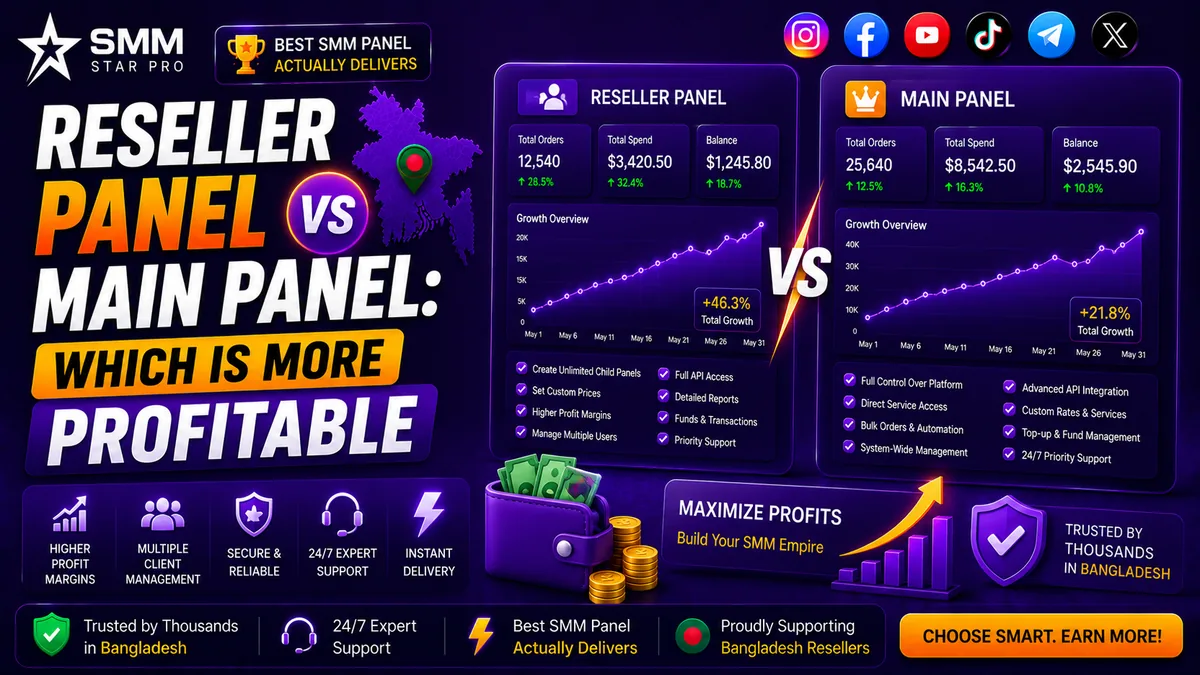
Main panel vs reseller panel: a look at cost, margins, control, and setup so you can pick the SMM panel type that fits your business right now.
A main panel plugs straight into suppliers using its own API keys. That means higher margins and full control, but it also asks for capital, several supplier accounts, and some technical setup before it earns a cent. A reseller panel, sometimes called a child panel, is a branded storefront wired into a main panel’s supply. It costs almost nothing and goes live instantly, but the margins are thinner and you lean on the parent panel for everything underneath. If you are just getting going, start with a reseller panel and move up to a main panel once your volume actually pays for the extra work.
It helps to stop thinking of the two as rivals. They are stages. Most operators who do well begin as resellers, learn the market without risking money, then build a main panel once demand is steady and they want to keep more of each sale. The rest of this guide compares them on the things that move your profit and your effort, and it builds on the groundwork in our walkthrough on launching your first SMM reseller business.
What’s the difference between a main panel and a reseller panel?
A main panel sits at the top of the supply chain. It holds direct API connections to wholesale suppliers, the actual sources of followers, likes, and views. It funds those supplier accounts and sells to end customers and to other resellers. Pricing, services, and supply are all in its hands.
A reseller panel sits one level down. It is a branded storefront connected to a single main panel’s API. It pulls in the main panel’s services, adds a markup, and sells to end customers. It never deals with suppliers directly. For supply, pricing, and uptime, it depends entirely on the parent main panel above it.
The chain is simple to picture: supplier feeds the main panel, the main panel feeds the child or reseller panel, and the reseller panel sells to the customer. Every link adds a markup, which is exactly why the position you occupy decides how much margin you keep. If the parent-and-storefront relationship still feels abstract, our deeper comparison of a main panel versus a child panel breaks it down further.
Main panel vs reseller panel: side-by-side comparison
Put plainly, the main panel wins on margin and control while the reseller panel wins on cost and speed. A main panel buys at the wholesale floor, sets its own prices, picks its own services, and answers to no parent, but it carries real expenses and ongoing maintenance. A reseller panel can be live today with no coding and almost no money down, yet its catalog and prices are capped by whoever it sits beneath. The right pick depends less on which sounds better and more on where your business is at the moment.
When should you choose a reseller panel?
Choose a reseller panel if you are:
- New to the business and want to learn how it works with zero financial risk.
- Testing a market before you commit any capital, since you can validate demand inside a few weeks.
- Non-technical and want a working storefront without coding, hosting, or supplier negotiations.
- Short on cash, because you fund orders only after customers have paid, so almost nothing comes out of pocket up front.
The whole appeal of a reseller panel is speed and safety. You can be taking orders the same day, and if the niche turns out to be a dud, you have lost next to nothing. The catch is that your parent main panel takes its cut, which caps your margin, and you can only sell what their catalog carries. For most people reading this, a reseller panel is the right first move. If you want a sense of the real numbers at this stage, see what the figures look like in our breakdown of realistic child panel earnings.
When should you choose a main panel?
Choose a main panel if you are:
- Already moving steady volume as a reseller and want to keep the margin your parent panel currently takes.
- Comfortable with the setup, meaning you can install a panel script such as PerfectPanel, arrange hosting, integrate payment gateways, and connect several supplier APIs.
- Able to fund larger balances spread across multiple suppliers.
- Planning to resell to other resellers, which only works if you are a main panel yourself.
The main panel pays off in margin and control. You buy at the true wholesale floor, set your own base prices, choose which services to carry, and you are not at the mercy of one parent panel’s uptime or pricing whims. What it costs you is actual money, technical work, and the day-to-day grind of managing supplier relationships and your own infrastructure. The API integration this involves is its own project, so do not underestimate the engineering time before the first order clears.
Can you start as a reseller and upgrade to a main panel later?
Yes, and this is the path I would point almost anyone toward. Start as a reseller to learn the market, build a customer base, and prove to yourself that you can market and support a panel. Once the orders are coming in consistently, the cut your parent panel skims off starts to feel like real money, and that is your cue to build a main panel.
The upgrade does not mean tossing out your reseller setup. You are graduating into a spot where you control supply. Your existing customers, your brand, and your marketing channels all come with you. All you are really doing is swapping the supply layer underneath, trading the parent main panel for direct supplier connections, which lifts your margin on every order you were already handling.
Which is more profitable?
Per order, a main panel earns more because it buys at the wholesale floor with no parent panel skimming a cut. But “more profitable” assumes you have the volume to cover the cost and the effort. A main panel with no customers just bleeds money on hosting and idle supplier balances, while a reseller panel backed by good marketing will out-earn it without breaking a sweat.
Profit tracks your stage more than your panel type:
- At low volume, the reseller panel wins thanks to lower cost and no overhead to carry.
- At high volume, the main panel wins because the margin you capture per order outweighs that overhead.
Match the panel to where your business actually is, not where you are hoping it lands six months from now. That single habit saves more beginners from sunk cost than any clever pricing trick.
Frequently Asked Questions
Is a reseller panel the same as a child panel?
Yes. “Reseller panel” and “child panel” mean the same thing: a branded storefront connected to a main panel’s supply.
Do I make more money with a main panel?
Per order, yes, because you buy straight from suppliers with no middleman cut. But that only holds if you have enough volume to cover the higher cost and overhead. At low volume a reseller panel comes out ahead.
How much does a main panel cost to set up?
Usually somewhere between $500 and $5,000 or more once you add up the panel script, hosting, payment integration, and the money needed to fund several supplier accounts. A reseller panel runs anywhere from $0 to about $50.
Can I switch from a reseller panel to a main panel?
Yes, and most operators do exactly that. Start as a reseller, build your customers and volume, then upgrade to a main panel to keep more margin on orders you are already processing. If you want to weigh your options before committing, the team behind our SMM service provider is happy to talk it through.
Which should a beginner choose?
A reseller panel. It is close to free, instant to set up, needs no technical skill, and lets you test the market without risk before you put real capital on the line.
Not sure where to begin? The fastest, lowest-risk start is a branded child panel, and you can set yours up through our reseller panel option.