
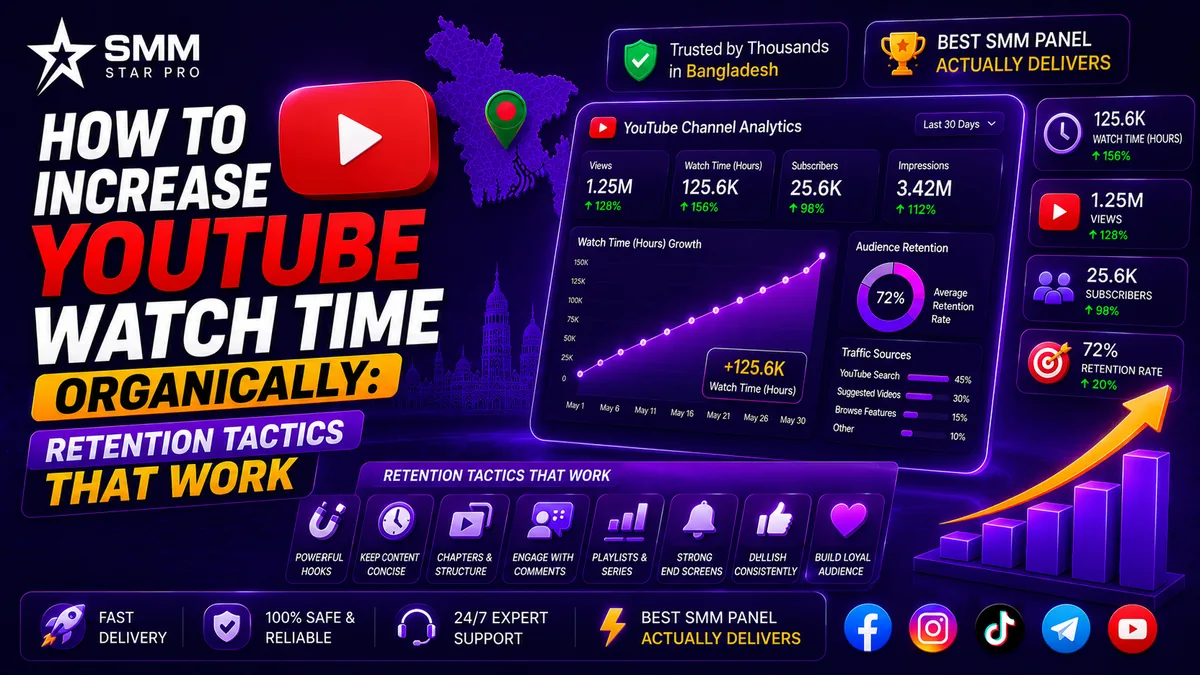
Increase YouTube watch time with stronger hooks, tighter editing, playlists, and end screens. Hit 4,000 watch hours faster and unlock monetization.
If you want more watch time, the basics are simple to say and hard to do well: hook people in the first 15 seconds, cut every dead second, throw in a pattern interrupt every half minute or so, and end each video by pointing straight at the next one. Watch time is just the total minutes people spend on your videos, and it happens to be the number YouTube cares about most. Push it up and the algorithm hands you more impressions.
It also decides whether you get paid. The YouTube Partner Program wants 4,000 valid public watch hours over the past 12 months before it lets you in. This guide walks through the retention tactics, the session tactics, and the structural changes that move both numbers at once.
What’s the difference between watch time and audience retention?
They are related but not the same thing. Watch time is the raw total of minutes people spend on your content, and that is the figure tied to monetization and to how much weight your channel carries overall. Audience retention is the percentage of a single video the average viewer actually watches, the curve you see in YouTube Studio.
There are two ways to grow watch time. You keep each viewer around longer, which is retention, or you get each viewer to watch more of your videos in one sitting, which is sessions. A 5-minute video held at 60% retention gives you 3 minutes of watch time per view. Lift retention to 75%, or chain a second video onto the first, and you have doubled that without earning a single extra impression. The two levers stack, so it pays to work both.
How do you write a hook that stops people leaving?
On nearly every video, the biggest drop comes in the first 15 to 30 seconds. Win that stretch and the rest of the curve tends to flatten out. Open with the payoff or the stakes right away. No channel intro, no “hey guys, welcome back, don’t forget to subscribe.” None of it matters until the click happens, so pair a strong hook with a thumbnail and title that earn the click in the first place.
Three hook patterns that tend to hold people:
- Promise plus proof: say what the video delivers and show a quick glimpse of it. Something like “by the end you’ll have X, and here’s the result first.”
- Open loop: ask the question the video answers, then hold the answer back just long enough to pull them along.
- Pattern break: start mid-action or on an unexpected shot so the very first frame doesn’t look like something you can skip.
Pull up the retention graph in Studio for your last ten videos. A steep cliff in the opening seconds means the hook isn’t landing. A gentle slope means it is. Start with the worst offenders and fix those first.
How does editing pace affect retention?
Editing is where average view duration gets won or lost. Any second that doesn’t add information or feeling is a reason for someone to leave. Cut the pauses, the “um”s, the points you already made, the slow setups. Tighten it until the video feels a touch too fast, because that is usually about right for how people watch online.
Drop in a pattern interrupt every 20 to 40 seconds: a new camera angle, some b-roll, an on-screen graphic, a sound cue, a zoom. Each one resets attention and fights off the urge to scroll away. On-screen text or visual chapters help too. They tell a viewer “we’re moving to the next useful bit,” which keeps the people who are scanning for one specific part from bouncing on the whole thing.
How do playlists and end screens increase session watch time?
Session watch time is how long someone stays on YouTube after starting with your video, even if they wander onto other channels, and it’s a signal YouTube leans on heavily. The goal is to be both the start of that session and the reason it keeps going.
- Playlists auto-queue the next video, so someone who finishes one rolls straight into another of yours. Group them by topic so the next pick is obviously relevant.
- End screens live in the last 5 to 20 seconds and should send people to one specific related video, not a vague “thanks for watching.” Tell them exactly what to watch next and why it’s worth their time.
- Cards can surface a related video right when you mention a topic you’ve covered elsewhere.
Treat every video as a doorway into a chain rather than a dead end. The structural side of this, the titles and chapters and metadata that keep people oriented, is also what turns casual watchers into regulars, which is the same thing covered in this walkthrough on earning your first thousand subscribers. The retention that builds watch time is the same retention that builds a subscriber base.
How many watch hours do you need, and how do you reach them faster?
The Partner Program threshold is 4,000 valid public watch hours across the trailing 12 months, plus 1,000 subscribers. There’s also a Shorts route of 10 million Shorts views in 90 days. “Valid public” leaves out private, unlisted, deleted, and obviously fake views.
To get there sooner, lean on longer videos that genuinely hold attention. A 12-minute video at 50% retention banks far more hours than a 3-minute one. Build playlists so views chain together, and go back and refresh older videos that still pull search traffic, because those quietly rack up hours for years. Some creators give a new channel’s watch-hour base an early push with a paid watch-time boost so the milestone shows up sooner. Whether that actually helps with monetization is worth thinking through carefully. If you do use it, treat it as a supplement to retentive content and never a replacement, because only real retention keeps the algorithm recommending you.
How do Shorts and long-form differ for watch time?
Shorts rack up huge view counts but add little to the 4,000-hour long-form requirement, since Shorts watch time gets counted on its own track. What they are good at is discovery and dragging new viewers toward your channel. Long-form is where the watch hours, the deeper retention, and the ad revenue pile up.
The pattern that works: use Shorts to pull people in cheaply, then turn that attention into long-form watch time with a clear nudge to go watch a full video, backed by playlists that hold them there. Don’t count on Shorts alone to clear the watch-hour bar. They are the top of the funnel, not the engine. If you want the wider picture, this watch-time playbook is just one piece of building a channel from the ground up, which also gets into niche, packaging, SEO, and how often you should post.
Frequently Asked Questions
How much watch time do you need to get monetized on YouTube? You need 4,000 valid public watch hours in the past 12 months plus 1,000 subscribers to join the YouTube Partner Program, or 10 million Shorts views in 90 days as the alternative path.
What is a good average view duration? Aim for at least 50% of the total video length on long-form. Above 60% is strong. The right benchmark shifts by topic and length, so compare against your own channel’s trend instead of chasing a fixed number.
Does rewatching a video count toward watch time? Yes. Genuine repeat views from real people count as valid public watch time, which is why highly rewatchable content like tutorials and reference videos piles up hours so efficiently.
Do Shorts count toward the 4,000 watch hours? No. Shorts watch time is tracked separately and does not count toward the 4,000-hour long-form requirement. There is a separate Shorts path of 10 million views in 90 days.
Can buying watch time get me monetized? It can shorten the time it takes to hit the watch-hour threshold, but YouTube reviews channels for genuine engagement before approving monetization. Purchased watch time only works when it sits under real, retentive videos, so treat it as a head start rather than a shortcut. You can compare delivery options and pricing across this SMM service provider if you decide to try it.
Closing in on 4,000 watch hours? Look at gradual, retention-friendly delivery options and give your monetization timeline a nudge.