
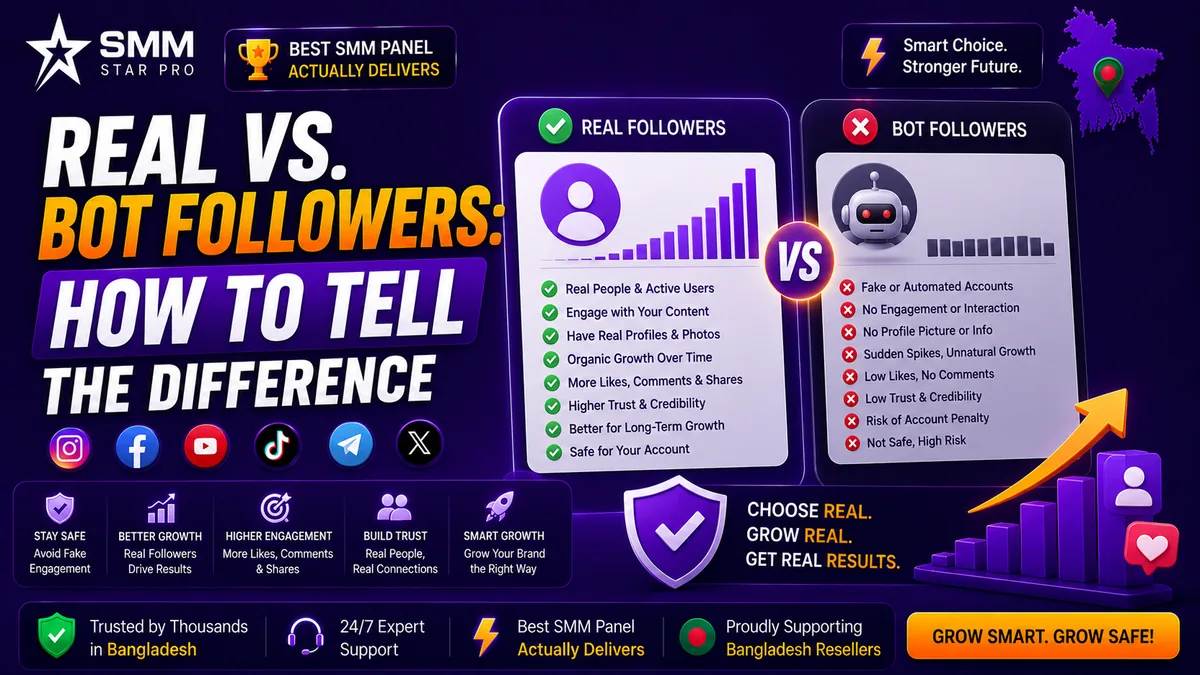
Real followers have profile pictures, posts, and a history of activity. Bot followers are empty, generic, and tend to vanish over time. Here is how to tell them apart before you spend a cent.
A real follower is an active account. It has a profile picture, some posts, followers of its own, and a track record of liking and commenting on things. A bot follower is the opposite: an empty account churned out in bulk, usually with no photo or a stock image, no posts, and a username that looks like a real name with random digits stapled to the end. Platforms purge those accounts in waves, which is why bought numbers so often slip away a few weeks later. The quickest test is to ask whether an account looks lived in or freshly stamped out by a script.
Knowing the difference helps you whether you are buying engagement or just auditing the audience you already have. If you are still getting your bearings, it is worth understanding how these reseller dashboards work and where the followers they sell actually come from.
What is the difference between real and bot followers?
It comes down to two things: whether the account is authentic, and whether it sticks around.
- Real or real-looking followers are genuine or aged accounts with believable profiles and real activity. They stay on your count, they can engage with your content, and they keep your engagement ratios looking sane.
- Bot followers are empty accounts spun up by automation. They pad your number for a while, never engage, and get wiped whenever the platform runs a cleanup. That cleanup is the “follower drop” people keep complaining about.
That one distinction is the single biggest gap between a cheap order and a quality one.
How can you spot a bot follower?
Bot accounts give themselves away. The usual signs:
- No profile picture, or a generic stock image.
- A username like user_8472913, or a normal-sounding name padded out with random numbers.
- Zero posts, or close to it.
- Following thousands while being followed by almost nobody, so the ratio is badly lopsided.
- No bio, or a spammy bio stuffed with irrelevant links.
- No engagement footprint at all. It never comments and never likes anything in a way that means something.
- Created in clusters, so you see a batch of new followers that all share the same patterns and show up at once.
One or two of these can happen with a perfectly real person. What you are looking for is a pattern of them across a batch of new followers. That is the bot signature.
How can you recognize real (or quality) followers?
Real and high-quality accounts send the opposite signals:
- A real profile picture of a person, a brand, or an object.
- Anywhere from a handful to a lot of posts, with comments and likes on them.
- A follower-to-following ratio that looks balanced.
- A written bio, sometimes with a location or a few interests.
- Visible activity. They like, they comment, they watch stories.
This is the kind of account a quality service delivers. It costs more because aged, active accounts are harder to source, but they do not evaporate and they protect your engagement rate. If you want to see what that actually involves, here is how a real delivery process is supposed to work. When you place an order with a quality provider, this is what should land on your account.
Why does engagement quality matter?
Bot followers do not just underwhelm. They can actively work against you:
- Drops. When the platform purges bots, your count falls, and a falling count looks worse than never having bought in the first place.
- A diluted engagement rate. Fifty thousand followers pulling 200 likes a post reads as fake to both the algorithm and to any real visitor, and it can quietly throttle your reach.
- Lost credibility. Brands and savvy users check engagement ratios before they collaborate, and obvious bots cost you deals.
- Algorithm distrust. Platforms favor accounts whose engagement matches their follower size. An account that looks artificially inflated can get pushed down.
Real engagement sidesteps all of that. It keeps your ratios believable, it survives the cleanups, and it backs up the social proof you are paying for instead of quietly undermining it. This is the same reason bought followers on their own rarely lift engagement unless the accounts behind them are real. The flip side, the actual risk of buying the wrong tier, is something I cover in more detail when I look at whether this kind of buying is safe in the first place.
How do you audit your own followers for bots?
To get a rough sense of how many fakes are on an account:
- Sample your recent followers. Open 20 to 30 of your newest ones and tally how many fit the bot profile above.
- Check your engagement rate. Divide average likes plus comments by follower count. Healthy numbers vary by niche, but a sudden collapse right after a follower jump is a red flag.
- Use a follower-audit tool. There are several free ones that estimate the percentage of fake or inactive followers for you.
- Watch for unexplained drops. Small, regular drops after a spike usually mean bots being purged in the background.
If you bought followers and you are seeing these patterns, the service was low quality. Next time, switch to a provider that offers a refill guarantee and real-looking accounts, and read up on whether buying followers is actually safe before you order again. Pairing a careful provider with the basics of keeping your account safe is what keeps a cleanup from ever touching you.
How do you make sure you buy real engagement?
When you are placing an order, look for a few signals on the service itself:
- It is labeled real or high quality, with an honest description of the account type.
- It comes with a refill guarantee, usually 30, 60, or 90 days, which is the provider putting its money where its mouth is on persistence.
- It offers drip-feed options so the growth looks natural instead of arriving in one suspicious lump.
- The reviews talk about retention, not just speed.
- The panel has a decent reputation overall.
Vetting the panel itself is its own job, and it is worth taking the time. A reputable complete SMM solution will be upfront about what you are getting and stand behind the order afterward. The rule of thumb is simple: if one service is dramatically cheaper than everyone else, it is almost certainly selling bots. You can compare the labeled tiers on a provider’s order pages to see how real and quality options are described before you commit.
Frequently asked questions
How can I tell if followers are real or bots?
Check the profiles. Real followers have pictures, posts, bios, and balanced ratios. Bots have generic usernames with random numbers, no photo, no posts, and lopsided following counts. A batch of empty accounts all showing up at once is the giveaway.
Why do bought followers disappear?
Because they were bots. Platforms periodically sweep out mass-created fake accounts, and your count drops when they do. Real, refill-guaranteed followers do not vanish like that.
Do bot followers hurt my account?
Yes. They dilute your engagement rate, can suppress your reach, damage your credibility with brands, and drop off over time, which often leaves you worse off than when you started.
Are “real” followers from SMM panels actually real?
Quality panels deliver aged, active accounts that look and behave like real users and stay on your count. They cost more than the bot tiers, and that is the trade-off for stability.
How many fake followers is too many?
There is no hard line. But a clear mismatch between your follower count and your engagement, plus visible empty accounts sitting in your follower list, points to a problem that can hurt both your reach and your reputation.
Want followers that actually stay? Pick a quality, refill-guaranteed service so the growth holds and your engagement rate stays intact.