
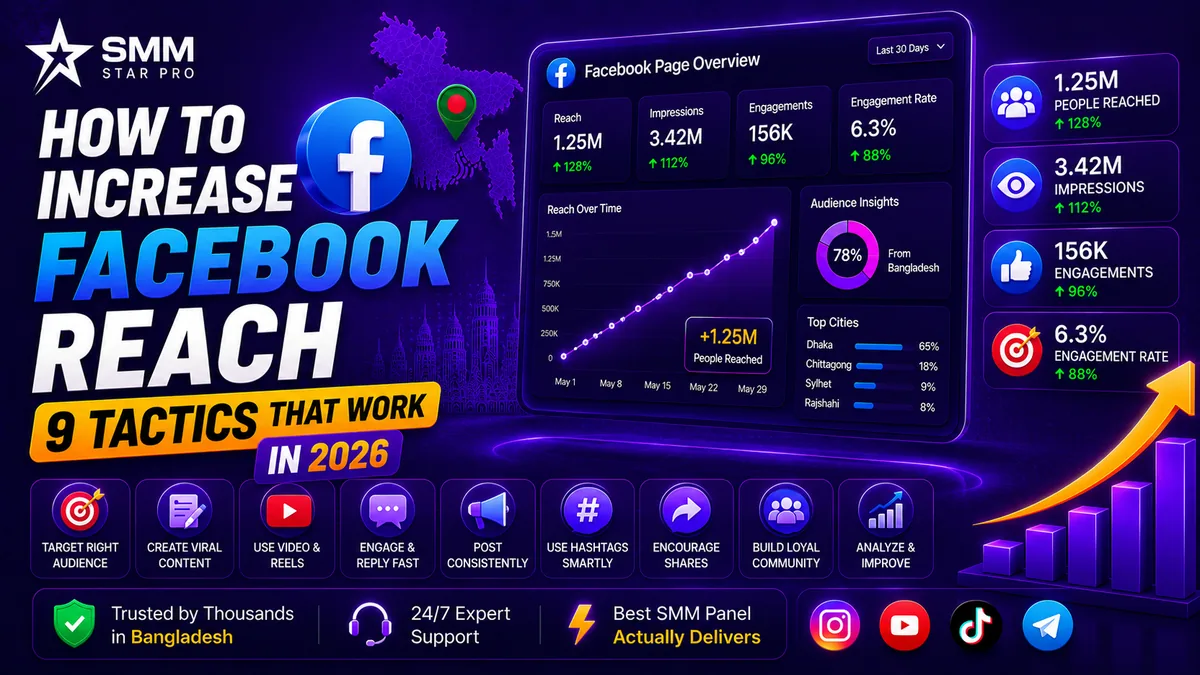
How to increase Facebook reach in 2026: lead with Reels and native video, build posts that get shared and discussed, post when people are actually online, and stop doing the things that quietly kill distribution.
If you want more reach on Facebook, the short version is this. Post Reels and native video, make content people want to share or comment on, keep external links out of the caption, and publish when your audience is awake. Facebook decides who sees a post based on how much engagement it expects that post to get. So reach is not a dial you turn. It is the result of the reactions your posts pull in.
What is Facebook reach and why is it dropping?
Reach is the number of unique accounts that see your content. Organic reach, the unpaid kind, has been sliding for years. The feed is crowded, and the algorithm gives the limited attention it has to the posts most likely to spark engagement. If your page still leans on plain text updates or link posts, you are feeling that drop the hardest. More posting is not the answer. Better posts are. This is really the whole game behind building an audience on a Facebook page, and reach is the number that decides whether any of it works.
How do I increase organic reach on Facebook?
Nine tactics, roughly in order of how much they move the needle.
1. Post Reels. Short vertical video is the one format Facebook still pushes out to people who do not follow you. In 2026 it is the biggest single lever you have.
2. Upload native video. Video posted straight to Facebook, not a YouTube link, gets favored in the feed and plays with captions during silent autoplay, which is how most people scroll.
3. Engineer shares. A share drops your post in front of a whole new network. Content that is useful, funny, relatable, or a little surprising gets passed around, and nothing multiplies reach faster than that.
4. Drive comments. Ask a one-line question. Post an opinion people can argue with. Use this-or-that prompts. Then reply to the first comments yourself to keep the thread alive and tell the algorithm the post is active.
5. Keep links out of the caption. Facebook throttles posts that try to send people off the platform. Put the link in the first comment instead and mention it in the caption.
6. Post at peak hours. The engagement a post earns in its first stretch decides whether it gets pushed wider. Check Page Insights for when your audience is online, then publish just before that window.
7. Be consistent. A steady rhythm, daily posts and four to seven Reels a week, keeps your page’s recent-performance signal healthy.
8. Use Stories and Live. Stories keep you in front of the followers you already have. Live video gets priority distribution and pulls real-time engagement while you are on.
9. Repurpose your best stuff. Re-cut your top Reels from TikTok and Instagram and run them again here. It is low effort for real reach.
Why do shares and comments matter most for reach?
Facebook ranks content by what it calls meaningful engagement, and the different signals do not count the same.
- Shares carry the most weight. A share is a personal endorsement that puts your post in front of an audience you could not reach on your own.
- Comments are close behind, especially longer ones and back-and-forth replies that grow a thread.
- Reactions sit in the middle. Love, Care, and Wow count for more than a plain Like.
- Clicks and dwell time are supporting signals that round out the picture.
Since shares and comments do the heavy lifting, build every post to earn at least one of them. A post that only collects likes reaches a sliver of what a shared post does. That same habit, designing for shares and comments, is what quietly powers earning more page likes and overall page growth over time. Once that reach is consistent, it is also what makes it realistic to turn a Facebook page into a source of income.
What kills Facebook reach?
Watch out for these.
- External links in the post body get throttled. Move them to the comments.
- Engagement bait like “tag a friend” or “comment YES” gets demoted by Facebook’s spam systems.
- Reposting watermarked TikToks backfires, because Facebook deprioritizes content stamped with another platform’s logo.
- Posting into dead hours means weak early engagement, and that caps how far the post travels.
- Inconsistent posting hurts you. Long gaps reset what the algorithm thinks of your page.
- Low-quality filler is worse than nothing. A suppressed post drags down your recent-performance average.
How can I boost early engagement on a post?
Early engagement decides distribution, so give a new post a fast start.
- Tell your existing audience it is live through Stories and cross-platform shares right after you post.
- Reply to the first few comments inside the first hour.
- Seed a few early reactions and shares. Some page owners use a service to add early post likes so a post can clear its initial distribution threshold, and a natural batch of extra shares early on can warm a post up before organic engagement takes over. Keep the volumes realistic so the signals still look authentic.
The logic mirrors the algorithm itself. Strong early signals trigger wider reach.
Frequently Asked Questions
Why is my Facebook reach suddenly so low? Usual suspects: external links in the body, engagement-bait phrasing, a drop in Reels, or a gap in posting. Switch to native Reels and design for shares and comments.
What is a good organic reach rate on Facebook? For static posts it commonly lands around 2 to 5 percent of followers, but Reels can go well past your follower count by reaching non-followers. Judge reach by the trend and by how your Reels do, not by one number.
Do hashtags increase Facebook reach? Barely. A couple of relevant hashtags add context, but they do not drive reach the way they can on Instagram or TikTok. Format and engagement matter far more.
How do shares affect reach? Shares are the strongest multiplier you have. Each one exposes your post to a new network, which is why shareable content is the highest-leverage tactic going.
Does boosting a post help organic reach? A paid boost lifts that one post’s reach and can spark organic engagement that carries it a bit further, but it does not permanently raise your baseline. Consistent, engaging content does that. If you want one place to manage both the paid push and the organic groundwork, a dedicated social media growth service can handle the engagement side while you focus on the content.
Give your next post the early momentum the algorithm looks for. A few authentic-looking reactions and shares early on can help it clear the distribution threshold while your organic engagement catches up.