
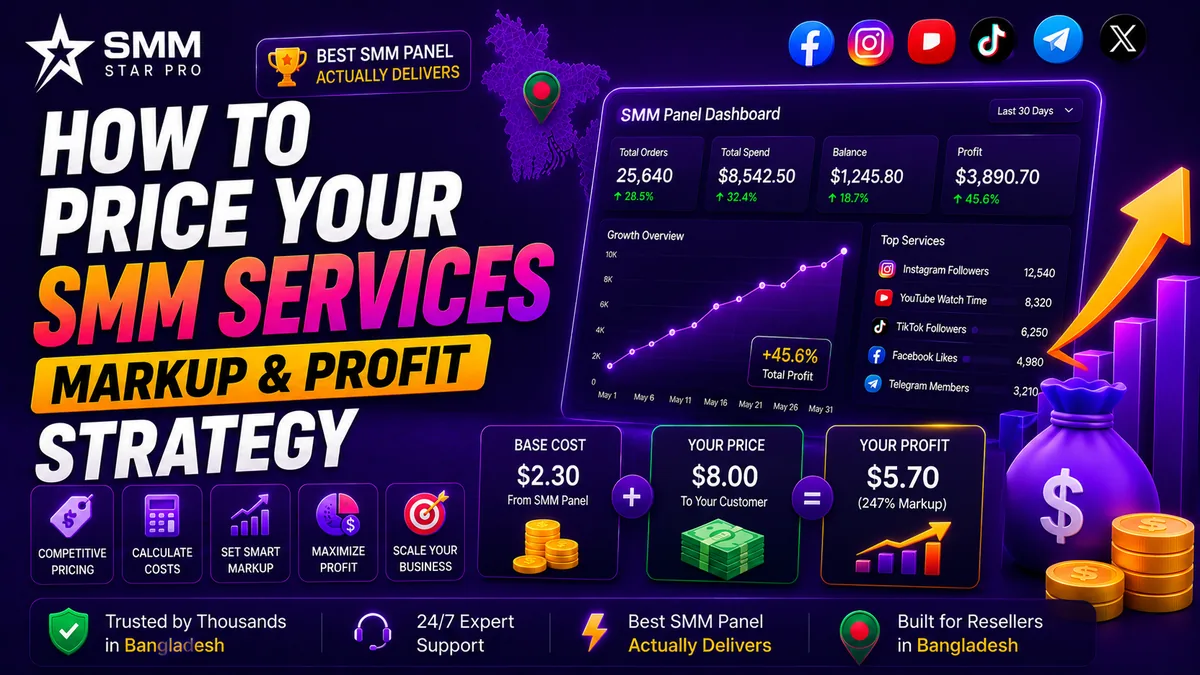
How to price your SMM services for profit: markup formulas, percentage versus fixed margins, tiered packages, and psychological pricing, with worked examples.
The short version: take the provider’s wholesale rate, add a percentage markup (usually somewhere between 100% and 300%), and let that retail price ride on top of the wholesale cost so it adjusts itself whenever the cost moves. Price the cheap, high-volume stuff like likes with thin margins because you win on turnover. Price the premium stuff, things like high-retention views or targeted followers, with fatter margins. And never set a price below your cost plus the payment fees.
Pricing is where a reseller actually makes or loses money. Everything else is logistics. Your markup is a balancing act between margin per order and how many orders you get: set it too high and the price-sensitive buyers walk, set it too low and you are working for pennies. This guide covers the formulas, the percentage-versus-fixed question, and the packaging tricks that turn the work of building a panel of your own into something that pays.
What’s the basic SMM pricing formula?
Every price you set starts from the provider’s rate, which is the wholesale cost per 1,000 units. Your retail price comes out of this:
Retail price = Wholesale rate × (1 + markup %)
Say the provider charges $0.80 per 1,000 Instagram followers. Apply a 200% markup:
$0.80 × (1 + 2.00) = $2.40 per 1,000
That leaves you $1.60 per 1,000 in profit. Before you lock the number in, pull out two costs that are easy to forget:
- Payment processing fees. These run 2% to 5% on cards, and sometimes more on regional gateways such as the bKash and Nagad options described in our guide to running an SMM business in Bangladesh.
- Refund and refill risk. Keep a small buffer for orders that drop and need topping up.
A price that ignores those two can look profitable on paper and still bleed money once the fees land. Price at cost plus fees plus margin, not just cost plus margin.
Should you use percentage or fixed markup?
Default to percentage markup. Provider rates move around a lot, and a percentage markup recalculates your retail price for you, so your margin holds without you touching anything. A fixed markup, the “always add $1.50” approach, falls apart the moment the wholesale price shifts. Either your margin quietly shrinks or your prices drift out of line with the market.
Most panel scripts, PerfectPanel and the ones like it, let you set a percentage markup per service or across the board, so prices reprice themselves whenever the provider updates. This is also why clean service imports matter. An imported service carries its current wholesale rate, and your markup sits on top of whatever that rate happens to be that day. If you are still choosing where to source from, a well-stocked reseller panel built for this makes the import-and-mark-up workflow a lot less painful.
How much markup should you add?
How much you add depends on where the service sits on the price scale and how fast it turns over:
- Cheap, high-volume services such as likes and basic views: 100% to 200%. People buy these constantly and they comparison shop, so keep the margin lean and win on volume. A 150% markup on $0.15 likes is still only $0.37 retail, which is cheap enough to move and turns over fast.
- Mid-tier services such as followers and standard views: 150% to 300%. This is the comfortable middle ground for most resellers.
- Premium services such as high-retention views, country-targeted followers, and guaranteed-refill packages: 300% and up. Buyers paying for quality care less about the exact price, so you can charge a real premium without scaring them off.
Worked out across a full catalog, the pattern is simple. The cheap services pull traffic through the door and the premium ones carry the profit. Those markups are also the lever that decides what your monthly income actually looks like once orders start flowing.
How do you research competitor pricing?
Do not price in a vacuum. Pull up three to five competing panels in your target market and write down their retail rates for the same services you plan to sell. You do not need to be the cheapest. Being the cheapest reads as low quality and drags everyone’s margins toward zero. Aim for the median instead, then back your price up with reliability, fast support, and refill guarantees.
Keep an eye on the floor. If competitors sell Instagram followers at $1.50 per 1k and your wholesale cost is $0.80, you have plenty of room. If your wholesale cost is $1.40, that service is not worth selling at the going rate, so switch providers or drop it. Where your margin ceiling sits also depends on your setup, which is why it pays to understand the difference between a main panel and a reseller panel before you fix your rates. Competitor research is mostly a way of telling which services still have margin and which ones have already been commoditized.
How do you use tiered packages and psychological pricing?
Tiered packages raise average order value and make the buying decision easier. Instead of a bare price-per-unit field, offer fixed bundles:
- 500 followers for $1.99
- 1,000 followers for $3.49 (better value per unit)
- 5,000 followers for $14.99 (best value per unit)
The middle and top tiers anchor against the smallest one and nudge buyers upward. Combo packages like “1,000 followers plus 1,000 likes” push order value higher still and feel like a deal to the buyer.
Psychological pricing tactics that work in this niche:
- Charm pricing. $4.99 instead of $5.00 reads as meaningfully cheaper even though it isn’t.
- Anchoring. Show a crossed-out “regular” price next to the one you are charging.
- Decoy tiers. A slightly overpriced middle option makes the top tier look like the smart buy.
- Round premium prices. For high-end services, a clean number like $25 can signal quality better than a fiddly $24.87.
How do you protect your margin over time?
- Use percentage markup so a provider’s rate changes don’t quietly eat your profit.
- Re-audit prices monthly against current wholesale rates and whatever competitors are doing.
- Drop low-margin services where the wholesale cost has crept too close to the market price.
- Build refunds and fees into every price, not just cost plus markup.
- Grow volume before you raise prices. Marketing scales your income with far less churn risk than a price hike does.
Pricing is not set-and-forget. The resellers who stay profitable are the ones who revisit their numbers as supply costs and competition shift. The full menu of what you can resell sits on our service catalog, which is a useful reference when you are deciding which categories to price aggressively and which to treat as premium.
Frequently Asked Questions
What markup should I use on SMM services?
Use 100% to 200% on cheap high-volume services, 150% to 300% on mid-tier ones, and 300% or more on premium or targeted services. Stick with percentage markup so prices adjust when wholesale rates change.
Should I be the cheapest panel?
No. The lowest prices signal low quality and destroy your margin. Price near the market median and compete on reliability, support, and refill guarantees instead.
Percentage or fixed markup, which is better?
Percentage, almost always. It scales automatically with provider rate changes and protects your margin. Fixed markup breaks the moment wholesale prices move.
How do tiered packages increase profit?
They raise average order value by anchoring buyers toward larger bundles and combo deals, and they make the decision simpler than a raw per-unit price.
Do I need to include payment fees in my price?
Yes. Card and gateway fees of 2% to 5%, sometimes more, come straight out of your margin. Price at cost plus fees plus margin, never cost plus margin alone.
If you want a second opinion on your numbers before you go live, our support team can talk through your pricing and flag anything that looks too thin.
The whole thing rests on cheap supply. Source your services at low wholesale rates through a reliable SMM platform so you have real room to mark up, then set prices that actually leave a margin.